Thursday, 26 February 2015

Is Role-Playing Fun?

Hello World,

I have talked about the positive effects of role-playing in previous blog posts. Discussing how it improves social skills and expand one’s understanding of the world around them. While that is all well and good, I got to thinking. Is the act of role-playing intrinsically enjoyable?

Now don’t get me wrong, I am not saying that role-playing can’t be fun, I am more saying that exterior factors generate the fun, not the act of getting in character. Thinking back on my experiences with role-playing games, the enjoyment always seems to stem from something other than pretending to be a fictional character. It comes from out witting an opponent in an argument, telling stories with friends, or even overcoming mechanically challenging situations within the game. And while each of these actions are strung together and enhanced by role-playing, they still stand-up without it. But can the same be said for role-playing? Is the sole act of acting like another person fun? If it is, why? Where does this enjoyment come from? Truthfully I haven’t come to a full conclusion on this and would love to hear your opinion on the matter in the comments below.


Before I open up this topic to discussion I would like to make a quick announcement. Over the next Month or so I will be featured on the GM academy’s inaugural season of Rally Cast. An RPG live stream hosted by the GM Academy which has a group of players from around the community run through a campaign in lesser known RPGs. The First episode will be streaming on Tuesday, March 3rd at 8:30 PM EST and can be found at the following LINK.

Thanks for reading, and I look forward to hearing your thoughts on role-playing.


- Patrick Lapienis

Wednesday, 18 February 2015

Trials of the Magi - Developmental Update [February]

Hello World,

This week on the blog I would like to share some of the progress made on the development of Trials of the Magi. The past month has gone by in a flurry, but a massive amount has been accomplished over a variety of different areas in the project. For starters, another round of playtests has concluded generating a lot of great feedback which has been used to improve the game. On top of this a large amount of time and effort has been spent working to complete the first draft of the game’s core rulebook. Currently all that is left is to finish off that last few core chapters and some preliminary editing. From there the draft will be released to the public for beta testing. The release of the first draft is on schedule and is to be posted prior to the Kickstarter’s launch in the middle of March.


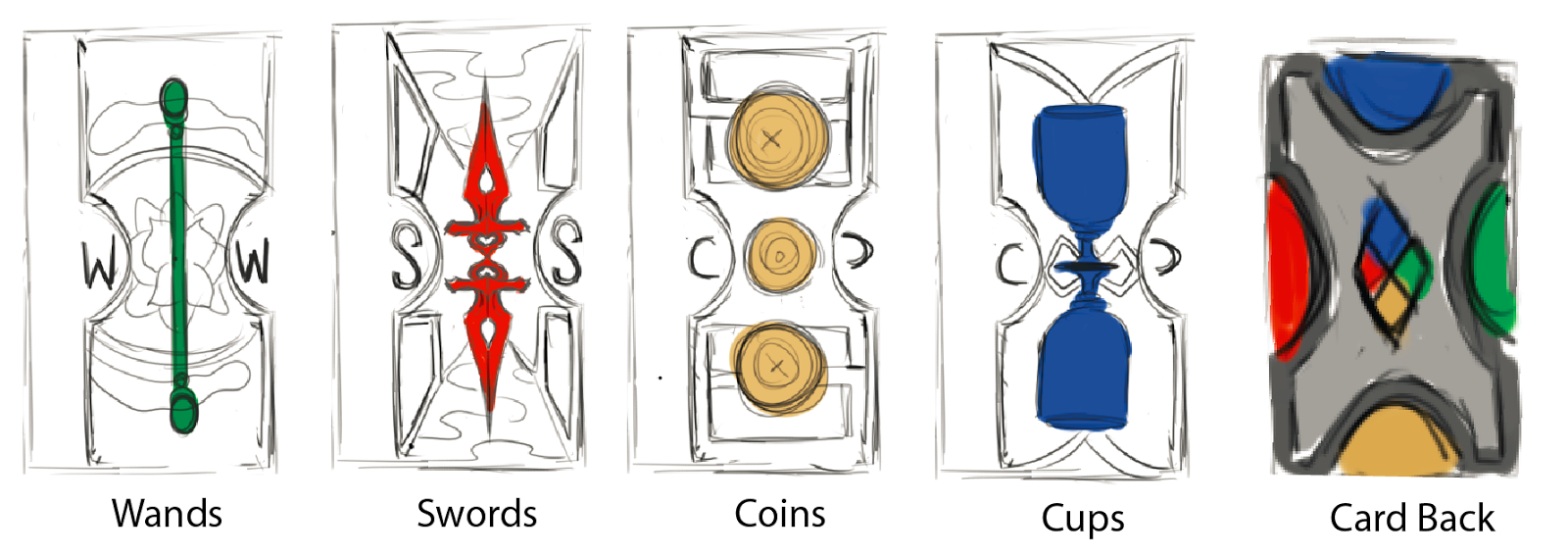
On the game’s artistic side there are two main channels of development. The first is art of the book which is spearheaded by Kayleigh Allen, who did the art for the Trials of the Magi NaGaDeMon entry. Currently Kayleigh is hard at work designing the cover art for the Trials of the Magi book. Which should be completed in the next week or so and once it is done I will be sure to share it on social media for all of you to check it out for yourselves. The other stream of artistic development is for the cards used within the game. The design of these cards is being done by Meryn Mercer, the same artist who created the cover art for my 48 hour RPG “Planet Crashers”. These cards have just finished the concept design phase and will be progressing into concrete designs in the following weeks. The concept designs for each of the cards found in the game’s Arcana deck can be seen below.


The third major area of development is with Sproutli’s website. This is a project we have been working on for quite some time and it is coming along nicely. The majority of the programming is done, all that is left to do is to add content onto it. When the website is launched next month there will be some features not yet implemented, these features being a player forum, storefront, and the relocation of this blog. This omission is due to the fact that web development is still a rather new area for our team and we would like to keep it’s initial launch as simple as possible. After launch however, these will be areas we intend to develop further.

With the Kickstarter launch of Trials of the Magi only a month away we here at Sproutli are exhilarated to see how far we’ve come, and are dedicated on delivering the best product we can. Be sure to look out for are launch by following us on Facebook, Twitter and Google+. Thank you to everyone who has lent us your support along the way, we couldn’t have made it this far without you!

As always, thanks for reading,

- Patrick Lapienis

Wednesday, 11 February 2015

Creating a Game Company: The art of multi-classing

Hello World,

Over this past year I have been working on something I couldn’t have even imagined myself doing, starting my own company. For those who aren’t regular readers, I have started a tabletop game design company by the name of Sproutli Games and we are taking our first big release to Kickstarter in a month. Within today’s blog post however I would like to share some of what I have learned whiles starting a company.

The first and most impactful thing that I have learned is that owning a company is a job of many hats. As a business owner, working on actual design work and game creation will become a much smaller portion of the time you spend on your company.   Most of the work you do will be spent doing project management, marketing and networking. While often not the most glorified work it pays off in leaps and bounds. Taking the extra time to let people know about your project, and ensuring the parties involved are on track can greatly aid your final product. Your limited design time can even be further syphoned off by processes such as legal affairs, copywriting, and building your online presence.

Another thing I would like to state is that owning a business isn’t easy. For the first few years or so you won’t be able to generate a sustainable income, meaning this is something that will have to be tackled on top of a job or school. Because of this it can often be hard to find time to work on your company. It’s easy to say “oh I have a big project due, the game can wait till tomorrow.” but this can quickly spread to a week with no progress, or even a month. This is why I commit myself to do at least one task towards my company every day. It actually reminds me of this quote:

“You keep putting one foot in front of the other, and then one day you look back and you’ve climbed a mountain.”

Truth be told, I think that is a great motivational statement for starting a business, it can be tough, and there will be times where you get lost in all of the different tasks. But in the end, if you just keep at it and do your best to deliver quality products it will all be worth it. That’s what I like to think at least.

If you have started a company or worked on a major project or game release, I would love to hear about your experiences. Please contact me using this blog’s contact form in the top right of this page. I would love to do a more in depth post about this topic in the future and would love you help in writing it.

As always, thanks for reading,

- Patrick Lapienis


Thursday, 5 February 2015

Making Games More Accessible

Hello World,

As those who keep up with my antics on Twitter and the blog would know, I have been developing a role-playing game for Kickstarter named of Trials of the Magi. An important component of this development is a custom deck of cards known as the Arcana Deck. Each of these cards has two important values upon it.

                1 – A suit which can be one of the 4 minor arcana [swords, wands, cups and coins]

                2 – A single-word noun which is created and written upon it by the player.

In my original design for the cards I had left a space in the top left of the card for the player to write their word, and had put a unidirectional suit symbol and name in the center. This design worked well in playtests, but it wasn’t until I began designing the official layout that I thought about the accessibility of the cards. While the current card layout worked fine for all of my right handed playtesters, it was very difficult to use for someone who was left handed.

I began looking at how I could make the cards easier to use in the left hand, and I came up with the design shown below. This layout extends the writable area to the bottom of the card and replaces the unidirectional suit information with a bidirectional symbol and name. With these changes made, a left handed player need only flip the card around and right their word in the top right to make it usable in the left hand.


But left handed players aren’t the only minority who can inconvenienced by a game’s design, there are tons of minorities and disabilities that find most games difficult to play. Some can be difficult to design around such as blindness, or deafness, but it still doesn’t stop people from trying. A prime example of this is the recently funded kickstarter campaign “Board games: now blind accessible” where a group of people are working to make board game modifications that can be added to existing games allowing them to be played by a blind person.

There are some minorities however that can be addressed rather easily if considered during the design of a game. Some examples of this are left handedness, color blindness, dyslexia or minor motor skill impairment. By designing for players with a variety capabilities and skills you can make your game accessible to a larger breadth of people. Tabletop games are already more accessible then sports and video games, and I think we can expand our audience even more.

I hoped you enjoyed this article and as always, thanks for reading,

- Patrick Lapienis


If you liked this article I have done a similar post on how inaccessible it is to start playing your first tabletop RPG. And if you are interested in trials of the Magi you can follow me on Twitter @MTTJ_Patrick or check out some of my older posts about the game. Which can be found HERE and HERE.

Thursday, 29 January 2015

Development of the Trials of the Magi Logo

Hello World,

 
Going to do something today that I feel I should be doing more of on this blog, discuss the development of my games. As some of you may know over the past few months my focus has been on the reworking and improvement of my National Game Design Month entry, Trials of the Magi. Work has been very intensive, with a strong focus on play testing and design. Through regular playtests with a large diversity of groups, the core game has become something that I believe is eloquent and that I am very proud of. Today though, I would like to talk about one subsection of the design process in particular. The design of the logo for Trials of the Magi.


When I began working on the logo, I first took a broad look at what my game was about. This was key step as a logo is the first thing a player associates with your and you want it to make a good connection to the game experience. Trials of the Magi is a game about arcane magic, manipulating the world around us, and exploring mental landscapes. With that in mind I began looking for fonts that fit this arcane theme. I choose to start with finding a font because it is often the most limiting aspect of a design. I get my fonts from www.dafont.com as they have a great supply of free fonts and some are even free to use for commercial use. Through my browsing I found a number of fonts that worked but only two that really stood out. With these two Ideal options found, I began organizing them in different layouts.

Having font and layout options found, we began to look at possible designs for the overall logo. With the game taking place in mental landscapes and the prominent featuring of the Fracture mechanic [Where characters and enemies fracture and shatter instead of death and injuries]. With this being such a unique feature, I wanted to encapsulate it in the title. So tried to include a broken or shattering glass design as a background to the title. Combining this with a space/nebula styled design created a nice arcane glass look. This was played with to create a variety of options. However, once I finished exploring this option, I decided to play around with the idea of an arcane  flame background. This idea showed some real potential and after a number of iterations it had become something I was quite happy with.


With a logo design drawn up I then confirmed that design and colors worked in on a white background, on a black background, in B&W and on a color background. After some minor adjustments to the colors, I was able to produce something that worked.

I may not be the greatest at graphic design, but I had an absolute blast creating the logo for Trials of the Magi. It is nice to be able to express my intentions through so many aspects of the project and I can’t wait to develop the game into a physical project. To Stay up to date on TotM’s development be sure to stay tuned to future blog posts or follow me on twitter @MTTJ_Patrick, and as always, thanks for reading.


-Patrick Lapienis

Thursday, 22 January 2015

Ending a Campaign with a Bang

Hello world,

I would like to start todays post with a question.

When was the last time a campaign you’ve run or played in come to a satisfying end?

In most of the cases I have observed through my own experience and talking to other veterans of the hobby, not very many. When the average person thinks of a tabletop RPG campaign they picture a long lasting grand campaign that spans years, the thought of it gets even me excited. This is because something on that scale is epic in every sense of the word. The problem with this is that it can only be achieved under perfect conditions. Gaming groups are volatile, players move, become too busy, or game masters get burned out. A whole number of things can get in the way of a grand scale campaign. Because of this the game ends up being cut short, ending on a patched together conclusion [or just stopping]. This is unsatisfying to all parties involved and today I am going to talk about some ways to make your campaigns have a memorable ending.

For starters, have a clear scope. When planning out a campaign try to have a clear beginning, middle and ending.  Doing this gives direction to your campaign and a set ending point to work towards. With that understood, I recommend trying to figure out how many sessions the campaign will last for. This is where I feel most long term campaigns go wrong. Just playing until the campaign naturally comes to an end is a sure fire way to end a game awkwardly. Look at both the your [as the game master] and the player’s availability over the duration you plan on running the campaign.

A good example of this is the Pokemon Tabletop RPG campaign I have just started running. Since I will be running this with other classmates at school, I knew the campaign had to conclude before the end of the semester, leaving me only 12-15 sessions depending on course load. Knowing this beforehand I was able reduce the number of gyms in the region to 6 [from the standard 8], and pace the game with a gym every other session. Without this knowledge the campaign would have been nowhere near completion before the group split apart.


My next bit of advice for ensuring campaigns have a good ending is to ensure that every session makes progress towards the finale. Nobody likes filler, and tabletop RPGs are already a time consuming hobby as it is. There is no need to draw the game out any further. When you are planning your sessions try to keep everything relevant to the goals of the game. If the group is concerned with creating a grand narrative, don’t bog down the game by roleplaying buying and selling goods with shop keepers. If you don’t know what your group is interested in, don’t hesitate to ask them. I have a habit of asking my players how they are liking the game after every session. Upon receiving feedback it is important to adjust the game to ensure that all of the players are having a good time.

Hopefully this helps you create some truly grand and epic campaigns, as always thanks for reading!


-Patrick Lapienis

Thursday, 15 January 2015

Meaningful Fluff: A Look at Character Creation

Hello World,

At the start of this month I moved in to a new apartment with my girlfriend. This apartment is rather far from my gaming groups and it has required me join and create new gaming groups. As a result of this I have created and help create 6 characters over the past week. By creating an abundance of very different characters for a variety of different systems, you start to see patterns in the character creation process.  This week on the blog I am going to talk about one tool of character creation that I find helps make meaningful and realistic characters.

This tool is what I like to call Meaningful Fluff, when  a characters backstory or narrative traits has direct impact on the characters skills and abilities. A number of systems include this in character creation. Some notable examples are HeroQuest 2, Dogs in the Vineyard, and even Dungeons and dragons 5E to a lesser extent. I find that while these systems include Meaningful Fluff, I feel it can be taken even further. It can be a driving force for your character.

In the Stars Without Numbers game I am currently playing, the GM has hacked a version of the “Keys” system from Lady Blackbird into the games character creation. Having never played Lady Blackbird, this was my first exposure to the mechanic and I fell in love with it. For those not familiar with it, the overarching premise is assigning a form of quirk or trauma that grants you XP boosts when it you role-play they trait, or it causes problems. This is where I find the system excels,  you want to pick Keys that you can use, and in doing so the Keys you choose shape who your character is.

As an example of this, my character in the Stars Without Number campaign was your stereotypical tech geek. But when it came time to pick keys, he became so much more than just a trope. When browsing the options the “Key of the Collector” caught my eye.

Key of the Collector: Your character is dedicated to obtaining as much –Blank- as possible. Gain 1 XP whenever she obtains information about the location of a piece of –Blank-. Gain 3 XP whenever she puts herself at risk in order to obtain –Blank-.

Now that I had picked a key, I had to find a way to incorporate it into my character. Simple enough, I just needed to figure out what he collected. After a bit of pondering I decided to say that he collects old outdated technology [Retro-Tech] in a futurist and sci-fi world. This led me down the rabbit hole of thinking about why he would collect old and obsolete technology, establishing his collection as an escape from his complex and confusing world to a much simpler world.  This was an interesting aspect of his personality that wasn’t even considered initially. Such a small creation tool directed me to create a more interesting and compelling character by giving a mechanical meaning behind the fictional fluff.  

A Picture of 'Kua' My SWN Character

Players are creative beings and if you give them a mechanical reason for giving their characters personality and flavor they will use that as a jumping off point to make interesting and unique characters. With that I wish you all the best in you future games and as always thanks for reading.

-Patrick Lapienis