Thursday, 29 January 2015

Development of the Trials of the Magi Logo

Hello World,

 
Going to do something today that I feel I should be doing more of on this blog, discuss the development of my games. As some of you may know over the past few months my focus has been on the reworking and improvement of my National Game Design Month entry, Trials of the Magi. Work has been very intensive, with a strong focus on play testing and design. Through regular playtests with a large diversity of groups, the core game has become something that I believe is eloquent and that I am very proud of. Today though, I would like to talk about one subsection of the design process in particular. The design of the logo for Trials of the Magi.


When I began working on the logo, I first took a broad look at what my game was about. This was key step as a logo is the first thing a player associates with your and you want it to make a good connection to the game experience. Trials of the Magi is a game about arcane magic, manipulating the world around us, and exploring mental landscapes. With that in mind I began looking for fonts that fit this arcane theme. I choose to start with finding a font because it is often the most limiting aspect of a design. I get my fonts from www.dafont.com as they have a great supply of free fonts and some are even free to use for commercial use. Through my browsing I found a number of fonts that worked but only two that really stood out. With these two Ideal options found, I began organizing them in different layouts.

Having font and layout options found, we began to look at possible designs for the overall logo. With the game taking place in mental landscapes and the prominent featuring of the Fracture mechanic [Where characters and enemies fracture and shatter instead of death and injuries]. With this being such a unique feature, I wanted to encapsulate it in the title. So tried to include a broken or shattering glass design as a background to the title. Combining this with a space/nebula styled design created a nice arcane glass look. This was played with to create a variety of options. However, once I finished exploring this option, I decided to play around with the idea of an arcane  flame background. This idea showed some real potential and after a number of iterations it had become something I was quite happy with.


With a logo design drawn up I then confirmed that design and colors worked in on a white background, on a black background, in B&W and on a color background. After some minor adjustments to the colors, I was able to produce something that worked.

I may not be the greatest at graphic design, but I had an absolute blast creating the logo for Trials of the Magi. It is nice to be able to express my intentions through so many aspects of the project and I can’t wait to develop the game into a physical project. To Stay up to date on TotM’s development be sure to stay tuned to future blog posts or follow me on twitter @MTTJ_Patrick, and as always, thanks for reading.


-Patrick Lapienis

Thursday, 22 January 2015

Ending a Campaign with a Bang

Hello world,

I would like to start todays post with a question.

When was the last time a campaign you’ve run or played in come to a satisfying end?

In most of the cases I have observed through my own experience and talking to other veterans of the hobby, not very many. When the average person thinks of a tabletop RPG campaign they picture a long lasting grand campaign that spans years, the thought of it gets even me excited. This is because something on that scale is epic in every sense of the word. The problem with this is that it can only be achieved under perfect conditions. Gaming groups are volatile, players move, become too busy, or game masters get burned out. A whole number of things can get in the way of a grand scale campaign. Because of this the game ends up being cut short, ending on a patched together conclusion [or just stopping]. This is unsatisfying to all parties involved and today I am going to talk about some ways to make your campaigns have a memorable ending.

For starters, have a clear scope. When planning out a campaign try to have a clear beginning, middle and ending.  Doing this gives direction to your campaign and a set ending point to work towards. With that understood, I recommend trying to figure out how many sessions the campaign will last for. This is where I feel most long term campaigns go wrong. Just playing until the campaign naturally comes to an end is a sure fire way to end a game awkwardly. Look at both the your [as the game master] and the player’s availability over the duration you plan on running the campaign.

A good example of this is the Pokemon Tabletop RPG campaign I have just started running. Since I will be running this with other classmates at school, I knew the campaign had to conclude before the end of the semester, leaving me only 12-15 sessions depending on course load. Knowing this beforehand I was able reduce the number of gyms in the region to 6 [from the standard 8], and pace the game with a gym every other session. Without this knowledge the campaign would have been nowhere near completion before the group split apart.


My next bit of advice for ensuring campaigns have a good ending is to ensure that every session makes progress towards the finale. Nobody likes filler, and tabletop RPGs are already a time consuming hobby as it is. There is no need to draw the game out any further. When you are planning your sessions try to keep everything relevant to the goals of the game. If the group is concerned with creating a grand narrative, don’t bog down the game by roleplaying buying and selling goods with shop keepers. If you don’t know what your group is interested in, don’t hesitate to ask them. I have a habit of asking my players how they are liking the game after every session. Upon receiving feedback it is important to adjust the game to ensure that all of the players are having a good time.

Hopefully this helps you create some truly grand and epic campaigns, as always thanks for reading!


-Patrick Lapienis

Thursday, 15 January 2015

Meaningful Fluff: A Look at Character Creation

Hello World,

At the start of this month I moved in to a new apartment with my girlfriend. This apartment is rather far from my gaming groups and it has required me join and create new gaming groups. As a result of this I have created and help create 6 characters over the past week. By creating an abundance of very different characters for a variety of different systems, you start to see patterns in the character creation process.  This week on the blog I am going to talk about one tool of character creation that I find helps make meaningful and realistic characters.

This tool is what I like to call Meaningful Fluff, when  a characters backstory or narrative traits has direct impact on the characters skills and abilities. A number of systems include this in character creation. Some notable examples are HeroQuest 2, Dogs in the Vineyard, and even Dungeons and dragons 5E to a lesser extent. I find that while these systems include Meaningful Fluff, I feel it can be taken even further. It can be a driving force for your character.

In the Stars Without Numbers game I am currently playing, the GM has hacked a version of the “Keys” system from Lady Blackbird into the games character creation. Having never played Lady Blackbird, this was my first exposure to the mechanic and I fell in love with it. For those not familiar with it, the overarching premise is assigning a form of quirk or trauma that grants you XP boosts when it you role-play they trait, or it causes problems. This is where I find the system excels,  you want to pick Keys that you can use, and in doing so the Keys you choose shape who your character is.

As an example of this, my character in the Stars Without Number campaign was your stereotypical tech geek. But when it came time to pick keys, he became so much more than just a trope. When browsing the options the “Key of the Collector” caught my eye.

Key of the Collector: Your character is dedicated to obtaining as much –Blank- as possible. Gain 1 XP whenever she obtains information about the location of a piece of –Blank-. Gain 3 XP whenever she puts herself at risk in order to obtain –Blank-.

Now that I had picked a key, I had to find a way to incorporate it into my character. Simple enough, I just needed to figure out what he collected. After a bit of pondering I decided to say that he collects old outdated technology [Retro-Tech] in a futurist and sci-fi world. This led me down the rabbit hole of thinking about why he would collect old and obsolete technology, establishing his collection as an escape from his complex and confusing world to a much simpler world.  This was an interesting aspect of his personality that wasn’t even considered initially. Such a small creation tool directed me to create a more interesting and compelling character by giving a mechanical meaning behind the fictional fluff.  

A Picture of 'Kua' My SWN Character

Players are creative beings and if you give them a mechanical reason for giving their characters personality and flavor they will use that as a jumping off point to make interesting and unique characters. With that I wish you all the best in you future games and as always thanks for reading.

-Patrick Lapienis

Thursday, 8 January 2015

Mechanics as Metaphor

Hello World,

Games are a very intimate medium as they allow us to interact with them on a level not seen in film or books. This interaction is performed through the games mechanics. Just like a game’s plot, visuals and audio, these mechanics are able to add meaning to an experience. This creation of meaning through mechanics is known as “Mechanics as Metaphor” and is a very hot topic in the world of video game design. Many video games have used this concept to great effect and I believe the same theory is transferable to the world of tabletop gaming.

Due to the free form nature of RPGs, a game’s plot, visuals and audio are often left in the hands of the player. This means that it can be very difficult to convey meaning through those areas and even when done the meaning is simple and abstract. A good example of this the setting of Glorantha in which players are heroes in a pre-apocalyptic world. The imagery and thought of being a hero even when you know the end of the world is coming, creates a very distinct style of campaign. But this also requires that the designer creates an in-depth setting for the game to take place in, which is a route a lot of games choose to forgo.

This leaves the most accessible tool to convey meaning within an RPG is through the mechanics. But this is not an easy task and requires very conscious planning on the part of the designer. This is because emotional aesthetics and meanings than arise from the combination of all of the game’s elements. The theory of game aesthetics was discussed in a paper by the name of Mechanics-Dynamics-Aesthetics (MDA) and is one of the first formally documented game design papers.

This paper discusses how a games mechanics, the rules and calculations, leads to a set of dynamics, the actual gameplay. From these dynamics aesthetics emerge, which are the emotional response created by the game. These aesthetics are the driving emotive reasons we play the game. The problem lies in the fact that designers and players approach a game from opposite sides. A designer starts with the mechanics and works their way through the dynamics to the aesthetics. While a player starts with the aesthetics and ends at mechanics. As a result of this the most important aspect to the player, the aesthetics, is often an after though to the designer. By establishing your core aesthetics early, you can design your games to better deliver upon them. Ensuring that all of a game’s mechanics and dynamics are building towards the same aesthetics allows for the game to generate a unified experience.


Mechanics act as the fundamental ground work that the game is built on. By consciously implementing a game’s mechanics in order to deliver on specific aesthetics. An example of this can been seen in one of my in development games by the name of Consortia. This game puts players in charge of a guild or organization and as a strong focus on fellowship and teamwork. As such one of the main mechanics within the game is the Bond System which grants character bonuses when working with characters who they have a strong relationship with. This mechanic often led to the dynamic of players combining their actions and working together to solve problems. Which would instill the aesthetic of fellowship in the players.

That is just an example of one mechanic delivering one aesthetic within the game. If within the game all of the mechanics enforce the core aesthetics, an enjoyable and concise experience being delivered. I wish all of you the best of luck on your future designs and thank you for reading

- Patrick Lapienis

If you are interested in learning more about MDA Theory I have written two other articles on it which can be found in the links below:


You can also find the original MDA paper HERE

Thursday, 1 January 2015

Anthology 2014

Hello World,

My first year of maintaining this blog comes to an end and as such I would like to take a page from Socrates RPG and do my first anthology. This year has been my first real big steps into the world of game design as I released two games, and even got the chance to talk with some veterans in this industry. I have learned so much over these past 12 months and I can’t wait to learn more next year. That’s enough reminiscing though, onwards to the anthology.

Most Popular Post of the Year:

Design Talks:

Tabletop Musings:

General Posts:                            

Overall it has been a great year and I look forward you sharing my experiences with all of you next year.

Thanks for reading,

-Patrick Lapienis

Thursday, 25 December 2014

Rolling with Impact

Hello world,

It’s the Christmas season, the time for ugly sweaters, creamy desserts and curling up next to the fire. This year I have chosen to catch up on my reading, and in doing so I stumbled upon a blog post titled “How Not to Notice Things” that caught my attention. Within this article the author talks about his opinion on perception checks. If you haven’t seen the article I strongly recommend it raises some excellent points and the examples  given are spot on. For those who haven’t read it, the focal argument of the piece is that a skill check outcome of “Nothing Happens” has no redeeming value within the game.

I agree with this completely, not only that but I believe  an outcome of “Nothing Happens” even take away from the game. If a player is making any form of check within the game, they are trying to influence the fiction in one form or another.

If the character succeeds and gets what they want, they feel powerful. Their character shaped the fiction to the their desire.

If the character fails, and the situation is escalated, the player is engaged. Their failure has either made things worse or raised the tension within the game. The player now wants to correct this mistake and is a lot more invested in the fiction.

If the character fails and nothing happens, the player is bored. They have tried to interact with the game, but were ultimately denied access because their character isn’t good enough. In this scenario, skill checks are solely a gating mechanic.  Meaning your character needs to be ‘this’ powerful or your rolls ‘this’ good if you want to play the game. This is a really bad practice as it completely disengages the player. Saying “Nothing Happens” is equivalent to telling the player their actions don’t matter and in a medium which is built upon expression, that is a huge problem. Every roll and action should try to get the player more invested and involved in the game. The best way I have seen to do this is by ensuring that every roll has a notable impact on the game, no matter the outcome. This doesn’t even have to be a mechanical impact it can purely be narrative.

The author of the article has a couple of really good examples in this regard. In their scenario ‘Steve’ is have a drink at a bar waiting to meet up with ‘Lacey’. During this time a rival enters the bar. The GM then requests the player to make a perception check to see if they notice the rival:


GM: “Steve, give me a Perception check.”
STEVE: “I rolled a five.”
GM: “Out of the corner of your eye, you see a guy walk in.  He looks familiar, but you don’t get a good look.”  (Steve can then act on this information.)

Alternatively:
GM: “Steve, give me a Perception check.”
STEVE: “I rolled a five.”
GM: 
“As you’re waiting on Lacey, a suspicious character walks in, heads to the back booth.  Before you do anything else, though, Lacey walks in and sits down next to you.”

The brilliance in both of these resolutions is that even though Steve fails, the game still progresses. In fact I believe the second example yields a more result than if Steve were to succeed. In the future when you are planning encounters or designing mechanics, think about how to engage the player through failure.  Because at the end of the day,  we are still playing role playing games, and as such we should aim to engage our players as much as possible.

Thank you so much for reading, and enjoy your holidays!


-Patrick Lapienis

Thursday, 18 December 2014

Experiential Goals Within Role-playing Games

Hello World,

There is an old adage with tabletop games called the ’20:4 Ratio’ that states within a 4 hour RPG session, the average player only experiences 20 minutes of fun.  While the ratio poses a rather unfair and generalized opinion, it wouldn’t exist if it didn’t hold some truth.  While there is a plethora of factors that limits the amount of fun to one tenth of a game, I believe it is most severely caused by a lack of coherence within the game.

Coherence is built when the players, system and surroundings all promote the same experiential goals. These experiential goals, often called a creative agenda, are the embodiment of what a player wants to achieve within the game. This agenda is different from person to person, and can fluctuate over time. One day you may really want to play through a challenging dungeon crawl, while another night you are craving a comedic adventure. The more the game you are playing aligns with your experiential goal, the more ‘fun’ you will have.

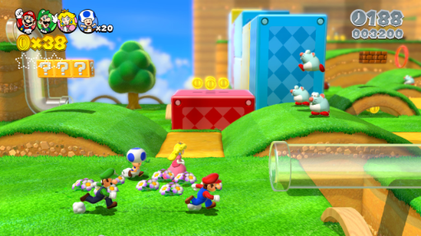
Thinking about it, I have never heard of something like the 20:4 Ratio occurring in video games. At least not to the same extent it has for tabletop RPGs. I think this is primarily due to how focused and concise video games generally are. When you start up a video game you know exactly what you are getting into.  Start up a game of Super Mario 3D World with some friends and all the players expect the same thing. They experiential goals align with that of the current game.

 “Complete the level with the most points”

It’s when the goals of the group don’t align that the experience stops being fun. For example, if one player in the above group wants to instead focus on collecting all the secret stars in each level while the others compete for points, the experience becomes a lot less enjoyable. However, if all of the players are make it their goal to collect the secret stars, the experience becomes fun again.

This is an area that I feel tabletop RPGs really struggle in. Within the same campaign each player can have drastically different experiential goals. This is due in part to a lack of communication within the group as to what game is going to be played. If the game master says he wants to run a cliché swords and sorcery themed game, different players get different ideas in their mind. One player thinks the game will be about traversing dangerous caverns to reclaim magical artifacts. While another wants the game to be about political intrigue in a mystical setting. The GM however may be prepping for an epic quest for revenge. All three of these players might as well be preparing for three different games. Within this campaign it is likely that the second player will only have 20 minutes of social intrigue in a 4 hour session. The game only aligns with his experiential goal one tenth of the time, giving him only 20 minutes of fun.

That premise of cliché swords and sorcery does not help the group focus on the games’ creative agenda.  What is more important is to determine the game’s aesthetic. If the game is going to revolve around gritty and challenging dungeon crawling, make sure everyone knows and is on board for that. Once the aesthetic is figured out, make everything build upon it.

- Have a setting that has danger around every corner and resources are sparse

- Pick a system that emphasises that style of play [Dungeons & Dragons / Pathfinder]

- Set up you play environment to echo the game, dim lighting [candle even],  dark and ominous/epic music playing or even some dungeon ambient noises.

Art Can be another good way to convey aesthetic

If all of the stimuli  within the game points towards the same aesthetic, the experiential goals of the players are more likely to align, leading to a much more enjoyable game. While this is a very extreme case the point still remains, try to make everything about the game consistent. More consistency means a higher likelihood that experiential goals will align.

If you are interest in learning more about this topic you can check out:


and


For now though, Thanks for Reading


- Patrick Lapienis